
AI Workflow Automation vs. RPA vs. AI Agents
How Fixed Automation, Intelligent Orchestration, and Bounded Autonomy Differ
Enterprise automation now includes tools described as robotic process automation, intelligent automation, AI workflow automation, agentic workflows, and AI agents. Vendors often use these terms loosely, which makes technologies with different operating models sound interchangeable.
They are not. RPA is strongest when software must repeat defined actions in predictable interfaces. AI workflow automation coordinates a broader business process and uses AI where interpretation, classification, prediction, or flexible routing is required. AI agents can decide which actions to take, use approved tools, and adjust their path toward an objective when the exact sequence cannot be fully prescribed in advance.
The boundaries can overlap. An AI workflow may call an RPA bot, and an agent may operate inside a governed workflow. The useful question is not which label sounds most advanced. It is which operating model fits the work, its variability, and the consequences of an incorrect action.
This guide explains how RPA, AI workflow automation, and AI agents differ, where each works best, how they can operate together, and what enterprise buyers should evaluate before choosing an approach.
Table of Contents
- Three Technologies, Three Operating Models
- What Is Robotic Process Automation?
- What Is AI Workflow Automation?
- What Are AI Agents?
- The Key Differences
- When to Use RPA
- When to Use AI Workflow Automation
- When to Use AI Agents
- How the Technologies Work Together
- Match Governance to Autonomy and Risk
- A Practical Selection Framework
- Measure the Business Result, Not the Automation Label
- How to Evaluate Enterprise Automation Solutions
- Frequently Asked Questions
- Use the Right Level of Intelligence
Three Technologies, Three Operating Models
The clearest distinction is based on how the automation determines what happens next.
- RPA follows: The automation executes a predefined sequence of user-interface or system actions.
- AI workflow automation coordinates: A workflow engine moves work through a designed process while AI interprets information, supports decisions, and handles defined variability.
- AI agents decide: An agent interprets an objective, selects among permitted tools or actions, and adapts its intermediate steps based on context and results.
This is not a simple progression from old to new. Predictability is often a strength because a deterministic process is easier to test, explain, audit, and control. RPA may be one component inside an enterprise workflow, and an agent may perform a bounded subtask while the workflow retains responsibility for approvals, state, monitoring, and recovery.
What Is Robotic Process Automation?
Robotic process automation uses software bots to reproduce defined actions that a person would otherwise perform in an application, such as selecting fields, copying information, entering data, moving files, or generating reports.
Microsoft describes desktop flows as a way to automate repetitive desktop processes and rule-based tasks across modern and legacy applications. That interface-level capability is one of RPA’s most important advantages. It can automate systems that lack suitable APIs or would be expensive to replace.
Traditional RPA depends on explicit rules, stable inputs, and known paths. Conditional logic and exception handling can make a bot sophisticated, but the designer still defines the permitted sequence.
RPA can operate in attended mode alongside a user or unattended mode through schedules, events, or queues. It is especially effective for high-volume data entry, reconciliation, file movement, report assembly, and legacy-system interaction.
Its primary weakness is brittleness. A changed screen, missing field, authentication interruption, or new business rule can cause failure. RPA programs therefore require monitoring, exception handling, change management, and maintenance.
What Is AI Workflow Automation?
AI workflow automation applies AI within a repeatable, multi-step business process. The workflow connects applications, data, rules, approvals, people, and automation components while AI handles work that conventional rules cannot perform efficiently.
Common AI functions include extraction, classification, summarization, prediction, intent detection, exception identification, and intelligent routing. The workflow still provides structure: a trigger begins the process, state is tracked, actions use defined permissions, and sensitive decisions can reach people.
In invoice processing, a workflow might extract invoice data, validate the supplier, compare a purchase order, route discrepancies, obtain approval, post the result, and preserve an audit trail. RPA may perform the final entry if the ERP lacks a suitable API, but the solution is broader than the bot.
The defining value is orchestration. AI workflow automation coordinates work across systems and participants while maintaining an explicit process model. It suits processes that are repeatable at the business level even when individual cases require different approved routes.
What Are AI Agents?
An AI agent pursues an objective with some degree of autonomy. It can interpret context, select from available tools, take actions, observe results, and revise its next step.
Microsoft describes an agent loop through the sequence of thinking, acting, and optionally learning. Google Cloud distinguishes predictable, sequential workflows from dynamic orchestration, where agents determine how to proceed without a fully predefined script. That runtime discretion is the central difference between an agent and a conventional workflow.
An agent might investigate a support issue by gathering account history, checking approved sources and service status, requesting missing information, and proposing a permitted resolution. The sequence may differ for each case.
Agents are most useful when variability is high, the path cannot be enumerated economically, and completion requires contextual judgment. Multi-agent designs can divide specialized work but add communication, security, performance, and failure dependencies.
Autonomy does not mean unlimited authority. Enterprise agents need explicit goals, tool permissions, data boundaries, action limits, approval rules, monitoring, and stop conditions. More consequential actions require stronger boundaries.
The Key Differences
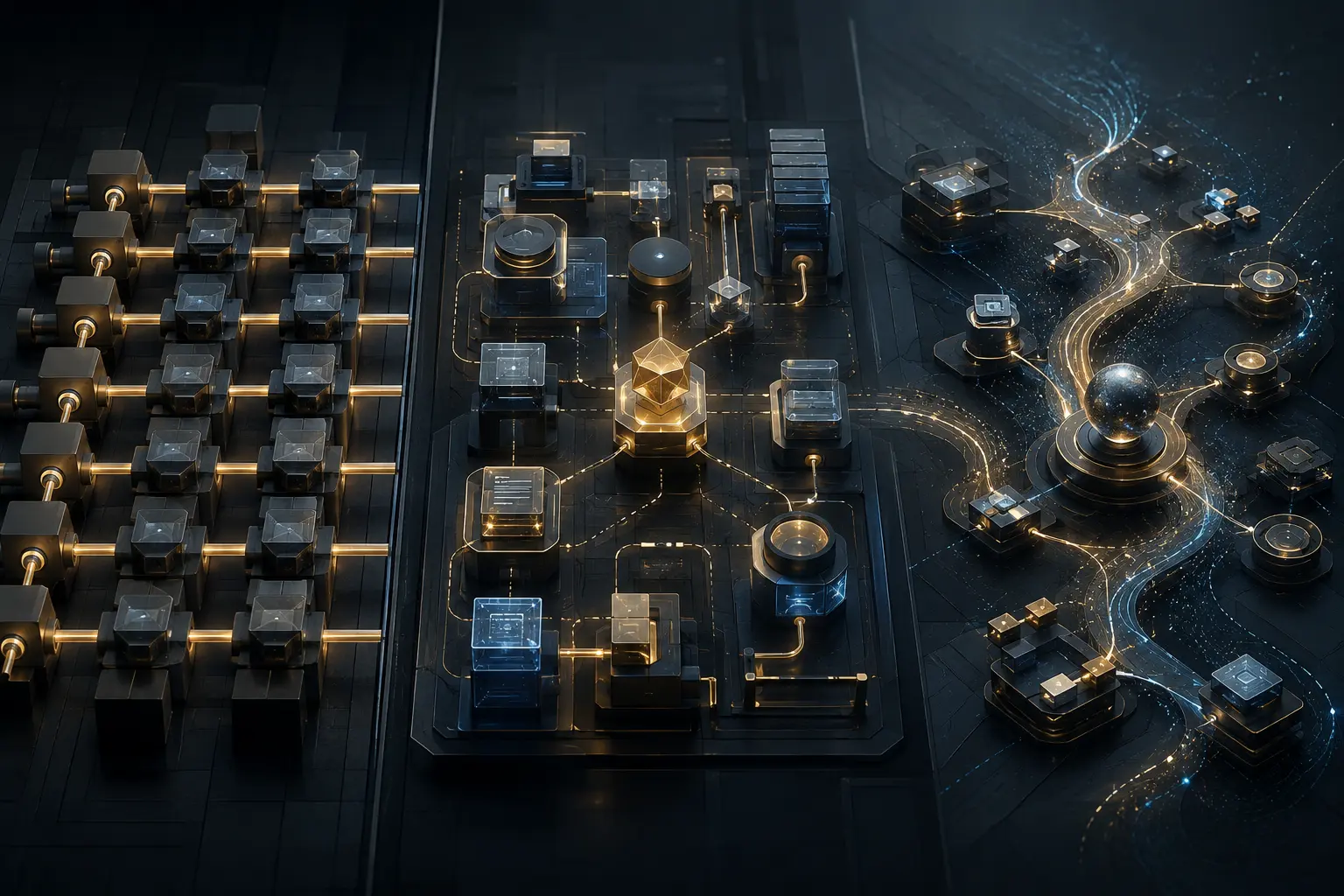
The technologies differ across six practical dimensions.
Process Path
RPA follows a prescribed sequence. AI workflow automation uses a designed process with intelligent decision points. An agent can determine intermediate steps at runtime within its scope.
Type of Work
RPA handles repetitive digital actions. AI workflow automation manages an end-to-end process. Agents address objectives requiring contextual interpretation, flexible planning, or tool selection.
Input Variability
RPA favors structured inputs. AI workflows process more variable information within a governed process. Agents can respond to greater variability, but are harder to predict.
Control and Explainability
Deterministic automation provides the clearest expected path. AI workflows require records of decisions, versions, approvals, and actions. Agents need deeper observability because the sequence can change between runs.
Failure Modes
RPA often fails when an interface changes. AI workflows may fail through poor output, routing, data, or integration. Agents add goal misinterpretation, tool misuse, privilege abuse, and cascading errors.
Operating Cost
RPA cost includes licenses, infrastructure, maintenance, and exceptions. AI workflows add model usage, evaluation, monitoring, and governance. Agents may add repeated model calls, latency, broader testing, and greater oversight.
When to Use RPA
Choose RPA when the task is stable, repetitive, digital, and based on explicit rules, especially when a required system does not provide a practical API.
Strong use cases include legacy data entry, file handling, routine reports, structured reconciliation, and other high-volume interface actions.
RPA is a poor fit when inputs vary substantially, exceptions dominate, applications change frequently, or the work requires judgment. Enough conditional branches can make maintenance exceed the value.
Do not replace predictable automation with an agent solely because agentic technology is newer. AWS guidance explicitly distinguishes deterministic workflows, where rule-based orchestration is ideal, from situations requiring flexible goal fulfillment. If the correct sequence is known, preserving that sequence can improve reliability and governance.
When to Use AI Workflow Automation
Choose AI workflow automation when the business process is repeatable but contains information or decisions that fixed rules handle poorly. The organization should know the process boundaries, required controls, responsible owners, and desired outcome even if each case follows a different approved route.
Strong use cases include document operations, triage, case processing, onboarding, compliance review, procurement, finance, and cross-system approvals.
The structure separates responsibilities. AI interprets information, rules enforce policy, RPA can operate a legacy screen, and people approve consequential exceptions. Orchestration maintains state, evidence, deadlines, and recovery.
This is why AI workflow automation is not merely RPA with a model attached. Its unit of design is the business workflow rather than the individual interface task. Organizations comparing broader categories should also distinguish AI workflow automation from AI business operations, where the primary value may be improving an entire function rather than executing defined process steps.
When to Use AI Agents
Choose an AI agent when the objective is clear but the path depends on context that cannot be fully anticipated. The flexibility must justify additional testing, monitoring, security, and governance.
Strong use cases include approved-source research, complex investigation, dynamic service resolution, adaptive planning, and specialized tool coordination.
An agent is a poor fit when the action is irreversible, the acceptable path is fixed, the evidence needed for a decision is unavailable, or the organization cannot define and enforce authority boundaries. High-risk work may still use agents for analysis or recommendation while reserving execution for a person or deterministic workflow.
Start with the narrowest useful scope. Limit tools, data, permissions, duration, and allowed outcomes. Require confirmation for sensitive actions, then test ambiguous instructions, missing information, malicious input, unavailable tools, and partial failure.
How the Technologies Work Together
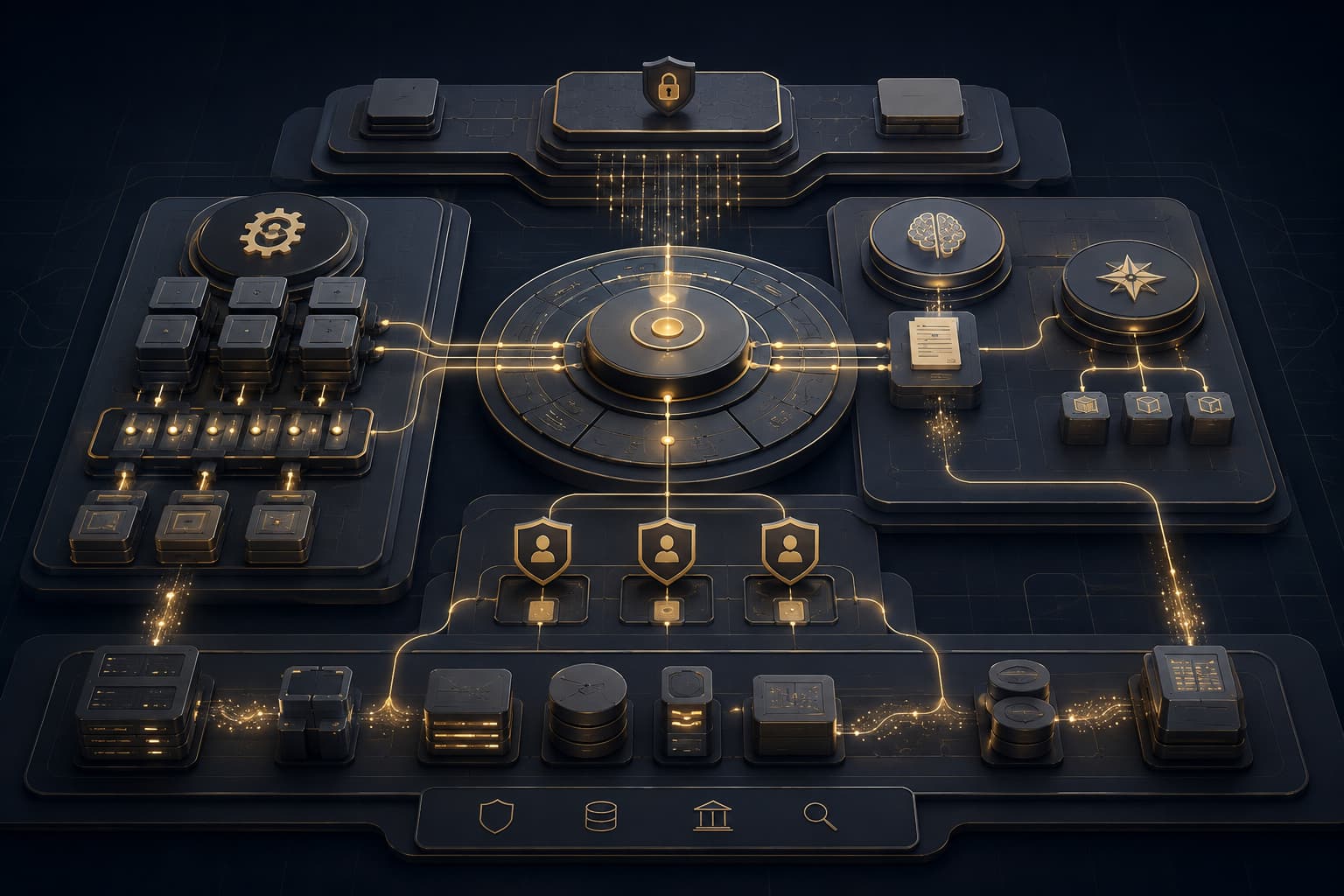
A mature automation architecture often combines the three approaches instead of selecting one for every task.
In vendor onboarding, a workflow can maintain the case while AI extracts documents, an agent researches approved sources, rules determine the review, a person approves higher-risk cases, and RPA updates a legacy procurement system. The workflow records the evidence and outcome.
Each component performs the work suited to its strengths:
- Workflow orchestration owns state, sequence, deadlines, approvals, and recovery.
- AI capabilities interpret information and support defined decisions.
- AI agents handle bounded tasks whose intermediate path must adapt.
- RPA performs predictable interface actions where direct integration is unavailable.
- People provide judgment, accountability, and approval where risk requires it.
This avoids asking an agent to manage state, every integration, every policy, and every failure. Autonomy belongs where it materially improves work, not where deterministic control already performs well.
Match Governance to Autonomy and Risk
Every automation requires governance, but the control model must change as behavior becomes more adaptive.
RPA governance covers bot identity, credentials, access, change control, versions, and exceptions. AI workflow governance adds data controls, evaluation sets, model and prompt versions, confidence thresholds, human review, monitoring, and traceability.
Agent governance must also address goals, tool permissions, identity, memory, action limits, delegation, inter-agent communication, and the possibility that one bad decision triggers several downstream actions. The NIST AI Agent Standards Initiative emphasizes secure operation and interoperability, while the OWASP Top 10 for Agentic Applications 2026 identifies risks including goal hijacking, tool misuse, identity and privilege abuse, memory poisoning, insecure communication, and cascading failures.
The broader NIST AI Risk Management Framework provides a useful lifecycle structure through Govern, Map, Measure, and Manage. Organizations should apply those functions to the complete automated system, not only the model or agent.
Production readiness also matters. Controls that appear sufficient in a demonstration may fail under real permissions, data, workloads, dependencies, and exceptions. The path from AI pilot to production requires the surrounding operating model to be designed as carefully as the automation itself.
A Practical Selection Framework
Use these questions to select the simplest reliable approach.
- Is the task path known? Prescribed steps favor deterministic automation, known branches favor a workflow, and runtime planning may justify an agent.
- How variable are the inputs? Structured inputs favor rules, unstructured inputs may require AI, and highly contextual objectives may justify agency.
- Does the process cross systems or people? If so, a workflow orchestration layer should usually own the end-to-end process.
- What happens when it is wrong? Higher consequences call for narrower permissions, validation, approvals, or a deterministic design.
- Can success be evaluated? Define expected outputs, operational measures, edge cases, and acceptance thresholds before deployment.
- Can the organization operate it? Account for monitoring, exceptions, security, governance, change, and support.
- Does added autonomy create enough value? Compare the benefit of flexibility with additional cost, latency, uncertainty, and risk.
This framework should be applied to individual process components, not only the solution as a whole. One workflow may contain a deterministic rule, an AI classification step, a bounded agent, a human approval, and an RPA task.
Measure the Business Result, Not the Automation Label
Measure automation against the operating baseline using cycle time, throughput, error, rework, exceptions, manual touches, cost per case, quality, capacity, and resolution time.
Do not assume that a more autonomous system produces a better return. An agent may handle cases that could not be automated previously, but repeated model calls and greater oversight can increase cost. RPA may be inexpensive for a stable task but costly to maintain across changing interfaces. AI workflow automation may improve the entire process while requiring more integration and change management.
The guide to measuring AI workflow automation ROI explains how to connect process metrics to usable labor capacity, cost, risk, and financial value. For broader programs, the framework for enterprise AI ROI and business impact includes total cost, attribution, adoption, and realized value.
Customer-facing automation requires an additional distinction. Faster or cheaper interactions do not automatically create a better experience. Organizations should understand where automation ends and customer experience begins, then measure both operational performance and AI customer experience business impact.
How to Evaluate Enterprise Automation Solutions
Buyers should ask vendors to demonstrate the operating model. Require them to show how cases begin, decisions are made, permissions are enforced, people intervene, and failures are detected and resolved.
Evaluate integration, data access, security, governance, reliability, observability, exceptions, usability, cost, support, and value. The checklist for evaluating an enterprise AI platform can help buyers test these claims under representative conditions.
Buyers should determine whether the product is focused automation or a broader platform. The capabilities that define enterprise-ready AI remain relevant, but a workflow product executes repeatable processes while a broad platform supports many AI use cases.
Finally, insist on evidence. Production results, customer references, evaluation data, failure testing, architecture, controls, and measurable outcomes are more useful than claims of being autonomous or intelligent. Those same principles explain what makes an enterprise AI solution award-worthy.
Frequently Asked Questions
Will AI agents replace RPA?
No. Agents can handle some work that is too variable for traditional RPA, but predictable interface tasks often benefit from deterministic execution. RPA can also serve as an execution component that an AI workflow or agent invokes under controlled conditions.
Is AI workflow automation the same as intelligent automation?
The terms overlap, but intelligent automation is often used broadly for combinations of AI, RPA, business process automation, and related technologies. AI workflow automation is more specific: AI is central to coordinating, routing, completing, or optimizing a multi-step workflow.
Can a workflow include an AI agent?
Yes. A governed workflow can invoke an agent for a bounded task, provide its context and tools, require approval for sensitive actions, then use the result in subsequent deterministic steps. This is often safer and more observable than allowing the agent to own the entire process.
Does using generative AI make a workflow agentic?
No. A workflow may use a language model to extract, classify, summarize, or generate content while the process path remains predefined. It becomes agentic when the system has meaningful discretion to select actions or determine intermediate steps toward an objective.
Which approach is easiest to audit?
A well-designed deterministic process is generally the easiest to audit because its expected path is known. AI workflows and agents can also be auditable, but they require records of context, model and prompt versions, tool calls, decisions, approvals, outputs, and changes in behavior.
What is the safest way to introduce AI agents?
Begin with a narrow, reversible, and observable task. Limit data and tools, use least-privilege access, define success and stop conditions, test adversarial and failure scenarios, require approval for consequential actions, and expand autonomy only when evidence supports it.
Use the Right Level of Intelligence
RPA, AI workflow automation, and AI agents solve different automation problems. RPA reproduces known actions. AI workflow automation coordinates a repeatable process and applies intelligence at defined points. AI agents add discretion when the system must determine how to pursue an objective.
The best enterprise architecture may use all three, but it should not use any of them indiscriminately. Stable work deserves stable automation. Variable information may require AI inside a governed workflow. Dynamic objectives may justify a bounded agent. Human judgment should remain where accountability, ambiguity, or consequence demands it.
Start with the work, not the label. The goal is reliable business improvement with the right level of intelligence and control.
Sources
- Microsoft Learn, Introduction to Desktop Flows
- Microsoft Learn, Types of Process Automation
- Google Cloud, Choose a Design Pattern for Your Agentic AI System
- Microsoft Learn, Workflows With AI Agents and Models
- AWS Prescriptive Guidance, Orchestration Models: From Rule-Based to AI-Native
- NIST, AI Agent Standards Initiative
- NIST, Artificial Intelligence Risk Management Framework
- OWASP, Top 10 for Agentic Applications 2026
Review the category criteria, current-cycle dates, and submission information for AI solutions that automate repeatable workflows and deliver measurable operational impact.